How to Store Dried VegetablesRoom Temperature, Fridge or Freezer, and How Long They Keep
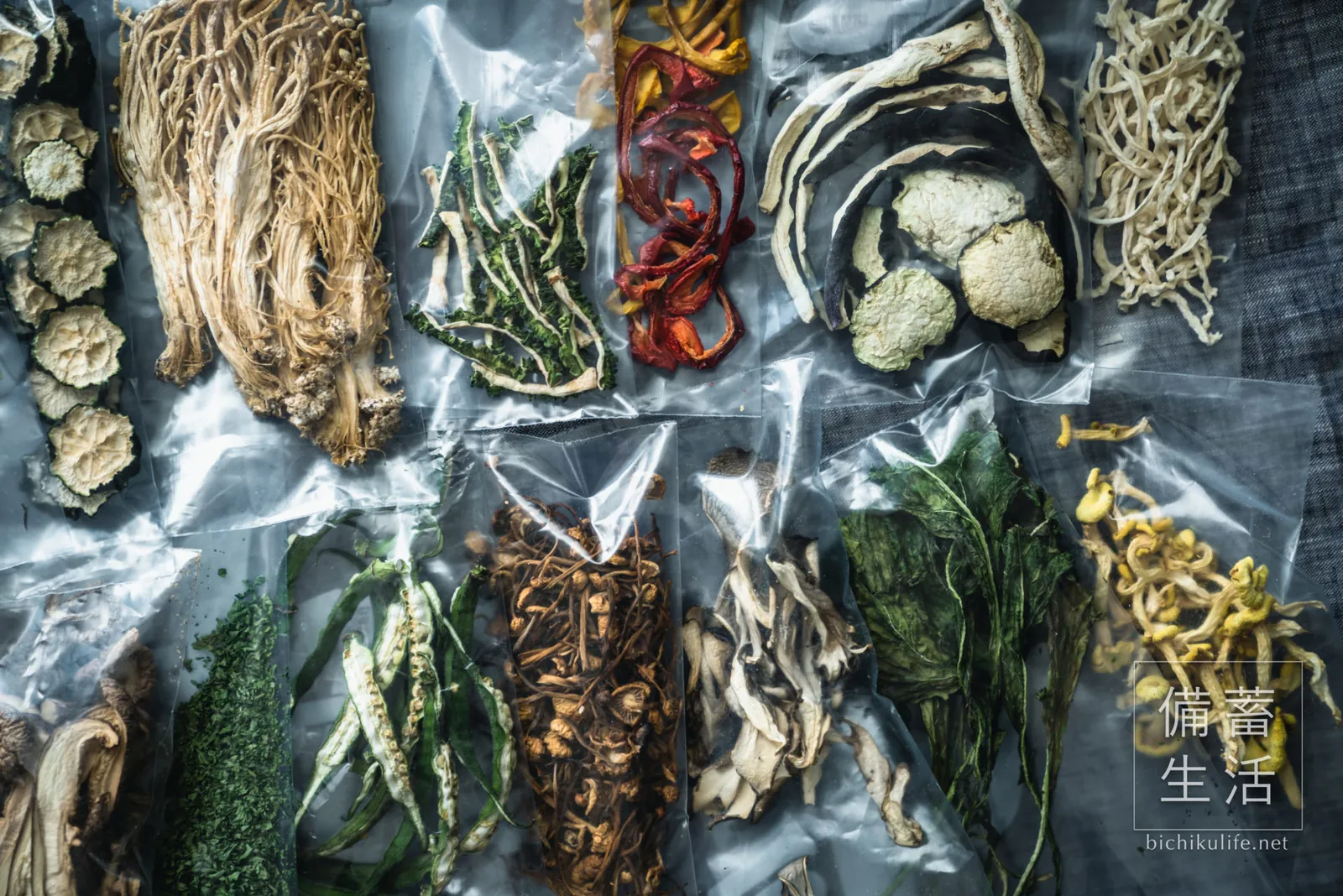
How you store dried vegetables depends on how dry they are.
- Fully dry and crisp: Store in bags or jars at room temperature.
- Dry but still leathery, and semi-dried (dried for half a day): Store in the fridge.
- To keep them longer: Either kind can be frozen.
Three basics
- Dry them completely: Any part that’s still a little moist is where mold starts during storage. When in doubt, give them another day.
- Cool them before bagging: If you bag them while still warm from the sun, droplets form inside the bag. Let them cool indoors and lose any moisture first.
- Keep out air and moisture: Press the air out of the bag before sealing, and add a desiccant. Keep it somewhere cool, out of direct sunlight.
How to tell if they’re dry
- Press with a finger: Is it hard, with no springiness or moist feel?
- Bend or snap it: Does it snap or crumble? (Some vegetables normally stay a little soft.)
- Check the slowest part to dry: The thick center, the middle of a mushroom cap, the beans in a pod, the base of a stem. If that’s dry, you’re fine.
Room temperature, fridge or freezer
| State | Where | How long | Examples |
|---|---|---|---|
| Fully dry and crisp | Room temperature (fridge in humid summer) | 2 weeks to several months | Dried daikon strips, dried shiitake, herbs, dried lemon |
| Dry but still leathery | Fridge | 2 weeks | Onion, green pepper, shishito peppers, green beans |
| Semi-dried | Fridge | 3–5 days | Most vegetables dried for half a day |
| Any | Freezer | 1–3 months | Use straight from frozen in soups and stir-fries |
Very juicy vegetables like napa cabbage and cabbage, which are hard to dry completely, also go in the fridge and should be used soon.
How long each type keeps (fully dry, room temperature)
| Type | How long | Examples |
|---|---|---|
| Leafy greens | 1 month | Shungiku, spinach, komatsuna, mitsuba |
| Fruiting vegetables | 2 weeks–1 month | Cherry tomatoes (fridge), eggplant, cucumber, bitter melon (1–2 months) |
| Roots and potatoes | 2 weeks–1 month | Carrot, daikon, burdock root, potato |
| Beans | 1–3 months | Fava beans, edamame (shelled) |
| Mushrooms | 3 weeks–3 months | Shimeji, enoki (3 weeks); shiitake, maitake, wood ear (3 months) |
| Herbs | 6 months (aroma lasts 2–3 months) | Basil, thyme, rosemary, green shiso |
| Fruit | 3 weeks–4 months | Kiwi (3 weeks); lemon, sudachi (4 months) |
Vegetables sun-dried at home may hold more water than store-bought dried vegetables. These times assume a desiccant and a cool place. Check for any change in smell or appearance before using. Each vegetable’s page gives its own guideline.
Containers and desiccants
- Zip-top bags (such as Ziploc): Clear, so you can see what’s inside, and you can write the date and name on the outside. Pressed flat, they take little space.
- Airtight jars: Herbs, crumbled vegetables and dried lemon slices are easy to take out of a jar, and they look nice.
- Desiccant: Add a food-safe silica gel packet. You can save the ones that come in snack and seaweed packages.
- Keep out light: Herbs and brightly colored vegetables fade in light. Keep them in a cupboard or a container that blocks light.
Mold, and changes that aren’t mold
Signs to throw it away- Fuzzy, cotton-like growth that is white, green or black
- Black or green spots
- A sour, fermented or musty smell
- Stickiness or slime
Even if you see mold on only a few pieces, it may have spread where you can’t see it. Throw away everything in the same bag or jar.
Changes that are fine- Dried daikon strips turning brown: A change in the sugars, not mold.
- White powder on dried sweet potato: The sweet potato’s sugar crystallizing.
- Slightly faded color or weaker aroma: The quality drops, but it hasn’t spoiled.
If they get damp
If something softens from moisture during storage and shows no mold or odd smell, dry it again in the sun, or in an oven at about 100°C (210°F), checking as you go. Then store it with a fresh desiccant.
A caution about storing in oil
If you put dried tomatoes or dried garlic in olive oil, always keep them in the fridge and use them up within about a week. Botulism bacteria can grow in oil, where there’s no air, so never leave oil with garlic or herbs in it at room temperature.
For your emergency pantry
Well-dried shiitake, dried daikon strips and herbs keep a long time, so they’re good for an emergency food stock. Use them in everyday cooking, and dry more to replace what you use.
The basics of drying are in How to Dry Vegetables.